










































































































































































































The eSIM Problem and the Need for a Solution
The Issue with eSIMs
The promise of eSIM technology—offering seamless connectivity, reducing security risks, and making switching carriers easier—has largely failed to materialize. Instead, eSIMs have made traveling more frustrating, with many carriers requiring physical SIM activation, limiting prepaid eSIM options, and enforcing strict ID verification policies.
Apple’s Push for eSIM-Only and Its Limitations
Apple removed the physical SIM tray from iPhones in the U.S., expecting a global shift, but adoption has been slow. While major U.S. carriers have adapted, international travelers still struggle to activate eSIMs abroad, making the eSIM-only model impractical.
The Role of Phone Manufacturers
For eSIMs to truly replace physical SIMs, Apple, Samsung, and Google must work together to standardize eSIM provisioning across all carriers. A cross-platform approach would allow users to switch between devices without relying on carrier intervention. However, carriers’ reluctance to facilitate easy activation remains a major obstacle.
The Call for a Unified Approach
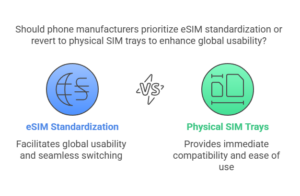
If phone makers continue with eSIM adoption, they must enforce global carrier compliance to improve usability. Otherwise, they should revert to including physical SIM trays in all phones. Until a comprehensive solution is implemented, eSIMs remain more of a hassle than a benefit for global travelers unless purchased separately and specifically per desired destination..
FAQs on the eSIM Problem and Potential Solutions
1. Why was eSIM technology introduced in the first place?
eSIMs were introduced to make mobile connectivity more seamless by eliminating the need for a physical SIM card. The idea was to:
- Free up internal space in smartphones.
- Improve security by tying the SIM to a device and reducing fraud.
- Allow users to switch carriers or activate new plans instantly.
- Make traveling easier by enabling users to buy and activate a local SIM without needing a physical card.
However, in practice, many of these benefits have not been realized due to carrier restrictions and inconsistent global implementation.
2. What are the biggest challenges with eSIMs today?
Despite their potential, eSIMs face several major issues:
- Limited adoption by carriers: Many carriers do not offer prepaid eSIM options, requiring users to first activate a physical SIM.
- Difficult activation process: Some carriers require a QR code, physical store visit, or ID verification, making it more complicated than simply inserting a physical SIM.
- Lack of universal support: eSIM compatibility varies widely between countries and carriers, making it unreliable for travelers unless they purchase the right package, like a global esim plan.
- Restrictions on switching devices: Transferring an eSIM between phones is often cumbersome and requires carrier assistance, unlike physical SIM cards, which can be swapped instantly.
3. Why does Apple push for an eSIM-only future while other phone manufacturers hesitate?
Apple has been an industry leader in pushing technological shifts, such as removing the headphone jack and introducing Face ID. By removing the SIM tray from U.S. iPhones, Apple aims to accelerate eSIM adoption. However, other manufacturers like Samsung and Google are hesitant because:
- eSIM adoption is inconsistent worldwide, making it impractical in many markets.
- Many users, especially in regions with poor carrier support, still rely on physical SIM cards.
- The lack of a universal standard makes eSIM activation more complex than simply inserting a SIM card.
Without cooperation from all major phone makers and global carriers, an eSIM-only future remains unrealistic.
4. What would be the ideal solution for making eSIMs work better?
For eSIMs to function as intended, the following changes are needed:
- Cross-platform standardization: Apple, Samsung, and Google must collaborate to establish a universal method for eSIM activation and transfer.
- Carrier cooperation: All carriers should allow users to activate eSIMs remotely, even when abroad, without requiring physical QR codes or ID verification delays.
- Instant device switching: Users should be able to move their eSIM from one phone to another as easily as they would with a physical SIM.
- Global roaming compatibility: More carriers should offer prepaid eSIM options that can be activated immediately in any country.
If these issues are addressed, eSIMs could become a superior alternative to physical SIM cards.
5. Will we ever see a fully eSIM-only future?
While an eSIM-only future is possible, it will depend on:
- Phone manufacturers enforcing adoption – If Samsung and Google follow Apple’s lead, carriers may be forced to improve eSIM support.
- Carriers adapting their systems – Unless carriers remove unnecessary restrictions, eSIMs will remain a frustrating experience.
- Global standardization – A unified approach to eSIM activation and security is necessary to make the technology reliable across all devices and networks.
At present, the fragmented implementation of eSIMs suggests that a physical SIM tray will remain necessary in many markets for the foreseeable future.
Staying connected while traveling
Staying connected while traveling internationally has always been a challenge, especially for frequent travelers who rely on seamless mobile services. eSIM technology was supposed to change that by eliminating the need for a physical SIM card, allowing users to switch networks effortlessly from a single device. Instead of searching for a local network provider or dealing with costly roaming fees, travelers could simply scan a QR code and activate a new eSIM in minutes. However, despite its promising capabilities, the reality of eSIM adoption has been far from convenient and flexible.
Are we really about to embrace eSIM technology
One of the biggest hurdles is that many carriers have been slow to fully embrace eSIM technology, making switching networks more complicated than it should be. While some mobile services offer eSIMs for Android devices and iPhones, users often encounter restrictions when trying to activate an eSIM abroad. Instead of being able to scan a QR code and instantly connect to a local network, many travelers still need to visit a store or verify their identity, which defeats the purpose of an eSIM’s seamless connectivity.
Beyond smartphones, eSIM capabilities extend to IoT devices, smartwatches, and even laptops, enabling a world where a single device can remain connected across multiple networks. For businesses managing fleets of connected devices or individuals who frequently move between countries, eSIM technology should offer a more streamlined experience. But until mobile providers improve their eSIM support, many users still find themselves relying on traditional SIM cards or searching for a stable Wi-Fi network to stay online.
Offering eSIMs should make mobile connectivity more accessible
The potential is there—offering eSIMs should make mobile connectivity more accessible, especially for frequent travelers and those who need to switch between networks often. If phone manufacturers and mobile carriers can collaborate to create a standardized eSIM process, users could finally enjoy a world where switching networks, activating a plan, and staying connected is as simple as scanning a QR code. Until then, the eSIM experience remains a work in progress, with significant improvements needed to make it the truly convenient and flexible solution it was meant to be.
esim vs physical sim
The Future of Seamless Connectivity with eSIM
eSIM technology has the potential to revolutionize mobile connectivity, making it easier than ever to stay connected while traveling internationally. With the ability to switch networks seamlessly from a single device, frequent travelers and tech-savvy users can enjoy a more convenient and flexible experience without relying on physical SIM cards. Offering eSIMs for Android devices, iPhones, and even IoT devices ensures a future where activating mobile services is as simple as scanning a QR code. As carriers continue to enhance eSIM support, the promise of a truly connected world is closer than ever.
Perguntas frequentes
eSIM was introduced to make mobile connectivity more seamless by removing the need for a physical SIM card, freeing internal phone space, improving security by tying the profile to the device, allowing instant carrier switching, and letting travelers buy and activate a local plan without hunting for a physical card. In practice, many of these benefits haven't fully materialized because of inconsistent carrier support worldwide.
Apple removed the SIM tray from US iPhones expecting the move to accelerate a global shift toward eSIM-only devices, following its history of forcing shifts like removing the headphone jack. Adoption has been slower than expected, though, since international travelers still struggle to activate eSIMs abroad in many markets, making a fully eSIM-only approach impractical outside a handful of well-supported regions.
Major issues include limited carrier adoption of prepaid eSIM options, activation processes that still require QR codes, store visits, or ID verification instead of instant setup, inconsistent eSIM support between countries and carriers, and restrictions that make transferring an eSIM between devices far more cumbersome than swapping a physical SIM card, especially for travelers relying on unfamiliar networks.
The article argues four things are needed: cross-platform standardization so Apple, Samsung, and Google use a universal activation and transfer method; broader carrier cooperation allowing remote activation without physical QR codes or ID delays; instant device-to-device switching; and wider global roaming compatibility with more prepaid eSIM options that activate immediately in any country a traveler visits.
Seja o primeiro a ver os guias de viagem da GlobaleSIM nas principais notícias do Google.